
FIGHTING FOR THE YAR
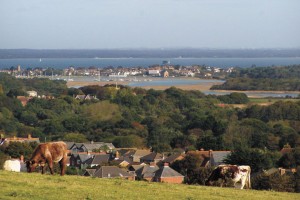 A KEY EMPLOYER in West Wight is taking a lead in the continuing battle to handle the effects of climate change.
The Yarmouth Harbour Commissioners estimate they will have to spend more than £4million rebuilding the breakwater that protects the Island’s Western Yar, its estuary and the town of Yarmouth.
“The recent relaunch of the 10:10 campaign reminded us that it’s not just what we do, or even how well we do it,” says Chris Lisher, harbour master and chief executive. “It’s a question of telling people exactly what we’re doing. As a business our commitment to dealing with climate change goes further than installing solar panels to cut the cost of hot water to the showers and ‘green energy’ electricity, though that does save us thousands of pounds a year.
“But we’re also taking the right action to protect the environment; the wildlife habitats, residential areas, roads and leisure activities.
“Investing in maintaining the breakwater at Yarmouth is a priority for the harbour commissioners. The current breakwater dates from the early 1960s and is made of old railway lines and sleepers. The steelwork is unlikely to last more than another 15 years. The Department for Environment, Food and Rural Affairs (Defra) predicts that the sea level will rise one metre by the end of the century.”
From the mouth of the river upstream to the causeway, the River Yar is home to an abundance of plants and wildlife. In the salt marshes glasswort, cordgrass, sea purslane and, in summer, sea lavender can be found. At low tide the mud reveals snails, shrimps, shellfish and marine worms. The tidal water of the Yar is a nursery for fish and a feeding ground for wading birds and waterfowl: dunlin, redshank, curlew, oystercatcher, shelduck, godwits and, in winter, brent geese.
There is a circular walk taking in Saltern Wood on the west bank of the Yar and the former railway line, now a cycle route and bridleway, along the east bank. Red squirrels live here.
“The Yar, a short river with a large estuary, is tidal for its five kilometres (three miles) north from the fresh water of Afton Marsh,” adds Charlotte Beeby, deputy harbour master. “If, thanks to climate change and rising tides, the sea breaks through anywhere on the Isle of Wight it breaks through below Old Freshwater. The ancient river flowing north to the Solent would be restored, this time as salt water with tides. Freshwater would be a separate island again.
“But the shoreline from Freshwater Bay via the Needles to Yarmouth Harbour alters all the time. This natural process has given us an attractive range of spectacular features… Freshwater Cliffs, Tennyson Down, the Needles, Alum Bay, Headon Warren, Totland Bay, Colwell Bay and more.”
Yarmouth Harbour, as the gateway to West Wight, welcomes more than 500,000 visitors a year by car ferry from Lymington, and 100,000 visitors by boat, many from elsewhere in the Solent, but also from Ireland, the Channel Islands, France, Belgium, Holland, Germany and Scandinavia.
The Yarmouth Harbour Commissioners have control of the Western Yar from the causeway, below Old Freshwater, to the harbour entrance where the river meets the Solent. They also have authority in the Solent for about one and a half kilometres (one mile) to the west of the harbour entrance and for about one kilometre (half a mile) out from the shore. The harbour is the largest employer in the town of Yarmouth with 20 permanent employees rising to 30 employees in the tourist season.
Yarmouth Harbour owns the wooden pier built in 1876, reputedly the longest wooden pier in the UK open to the public and grade II listed; operates the linkspan for the ferries; collects tickets from foot passengers; manages the harbour and river moorings; supplies marine fuel; operates the swingbridge; and provides a birth for the RNLI lifeboat. The harbour at the mouth of the Isle of Wight’s Western Yar also offers permanent moorings to 250 Islander-owned yachts and commercial vessels including 11 fishing boats. The swingbridge connecting Yarmouth with Freshwater is used by hundreds of drivers, cyclists and pedestrians, residents and visitors every day.
The IW Council is currently consulting the public on its shoreline management plan (SMP2). This considers that the breakwater at Yarmouth is critical for the protection of the river Yar, the estuary and the town of Yarmouth. For further details visit the websites www.yarmouth-harbour.co.uk and www.coastalwight.gov.uk/smp.
Related News Stories
- » PENSIONERS MEDICAL EPISODE LEADS TO SHANKLIN CRASH
- » TEENAGER BAILED
- » GRACIE LIGHTS UP LAKE
- » POLICE APPEAL AFTER WOMAN ATTACKED IN NEWPORT
- » LIFT IN BETWEEN FLOORS